
An engineer arrives with a wave theory
Augustin Fresnel's lighthouse work grew from scientific investigation and public engineering. The French Ministry of Culture traces his publication on diffraction to 1815 and his arrival in Paris, summoned by François Arago to supervise lighthouse-lighting experiments, to 1819. Its account describes a young civil engineer rather than an already famous beacon inventor. His story connects the behavior of light with the practical difficulty of making a coast legible to sailors: experimental knowledge had to become reliable equipment outside the laboratory. [1]
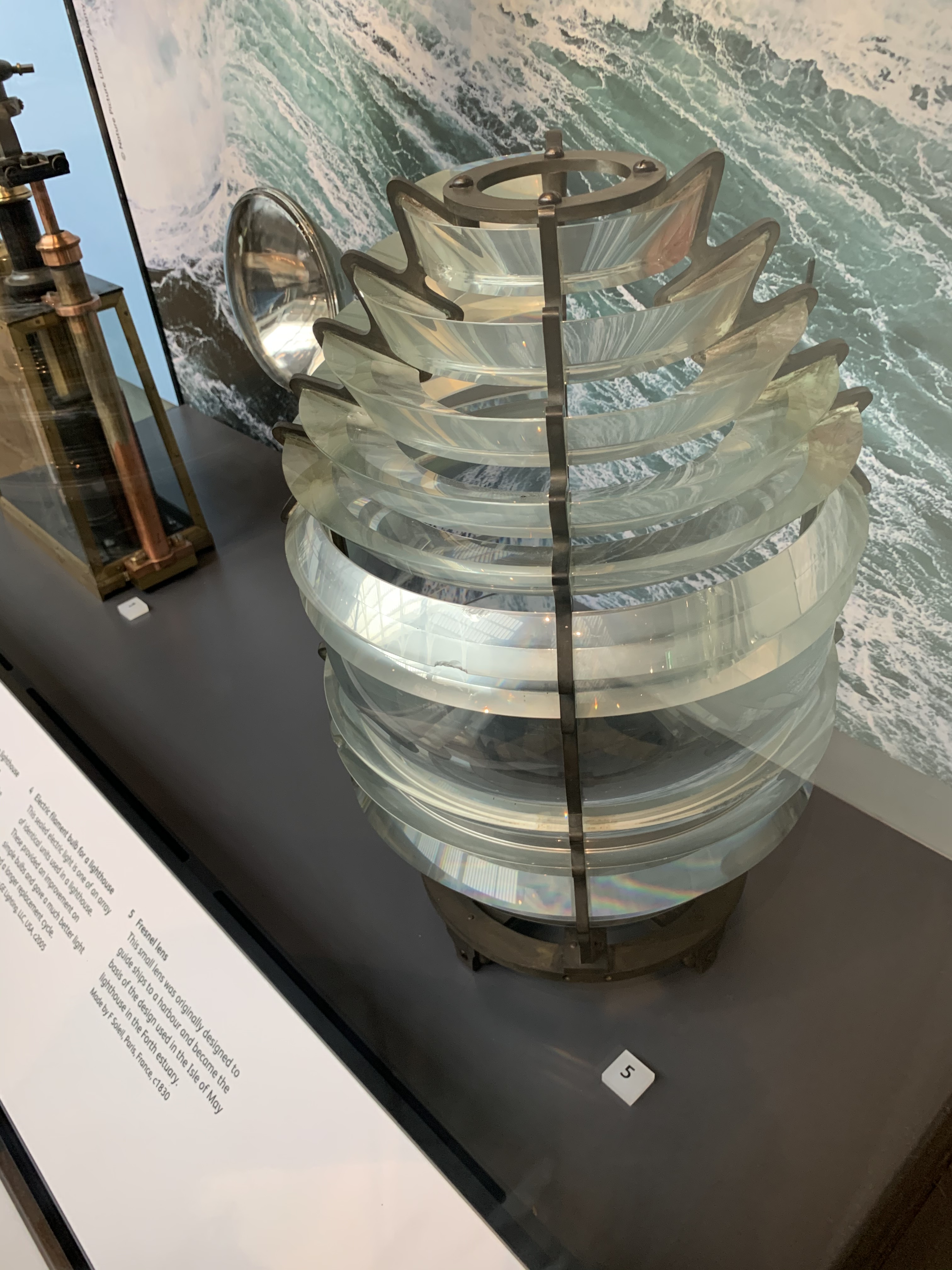
A Fresnel lens made by F. Soleil in Paris in 1830, photographed on display at the National Museum of Scotland in 2020. Its stepped rings make the chapter’s central idea visible: directing light depends on the optical system as well as the source. This is an unlit museum artifact.
Alf van Beem, 2020; photographed at the National Museum of Scotland, Edinburgh · CC0 1.0 Universal Public Domain Dedication by photographer View source and object record ↗
Read the 1822 claim carefully
Fresnel's 1822 Mémoire sur un nouveau système d'éclairage des phares is an identified contemporary historical text. In the Ministry's interpretation, Fresnel acknowledged an older optical principle: his proposal reversed the familiar burning glass. Instead of concentrating incoming light, it would organize light leaving a source. Construction and acceptance by experts and mariners were central obstacles. This account is an institutional reading of the memoir, not a claim that this website has inspected its original manuscript. Innovation here meant turning an optical idea into a usable public system. [1]
1822 design; July 1823 installation
The National Park Service dates completion of Fresnel's flashing-lens design to 1822. [3] The Cordouan heritage account places installation of his first lens there in July 1823. Eight stepped panels surrounded the lamp, with additional lenses and mirrors redirecting other rays. A weight-driven mechanism rotated the assembly; the keeper wound it daily. Fresnel also improved the source with nested cylindrical Argand wicks. Thus 1822 describes design work and 1823 a documented installation: those dates should not be collapsed into one universal invention event. [2]
A beam is distribution, not new light
The optical assembly concentrated otherwise scattered rays into selected directions. A rotating panel could produce a flash as it passed the observer; panel arrangement and rotation speed established the signal's timing. The individual pattern, or characteristic, helped mariners identify a light using navigational references. This is the essential distinction: the lamp produces light, while the lens distributes it and the mechanism sequences it. A stronger directional signal does not mean that glass manufactures additional light. [3]
Fire Island: an artifact with a traceable life
The surviving Fire Island first-order lens makes the history tangible. NPS records the present lighthouse's opening on November 1, 1858, with a revolving brass-and-glass optical assembly and a hydraulic lamp burning whale oil. The apparatus served until 1933 and later appeared at Philadelphia's Franklin Institute. After storage in more than thirty crates, it returned to Fire Island in March 2011 and was unveiled in July. These records identify a particular preserved object; they do not make every museum Fresnel lens an example of Fresnel's own original construction. [4]
Anacapa: one optical lineage, changing sources
Anacapa illustrates how light production and optics can evolve on separate schedules. NPS identifies its third-order lens as manufactured by Chance Brothers between 1900 and 1903, then installed in the lighthouse in 1932 with a 1,000-watt incandescent lamp. In 1989 an acrylic beacon lens replaced the original apparatus as the station converted to solar power. The historic glass lens moved to the visitor center and underwent conservation in 1993. The sequence connects glass optics, electric lamps, automation and a new energy supply without pretending they were one invention. [5]