
Begin with evidence in the room
A period-looking chandelier does not by itself prove historical authenticity. In IES LD+A, Chrysanthi Stockwell describes using surveys, archive photographs and preservation expertise to understand existing lighting and later alterations. Record what is present before deciding what to change. The evidence may support restoration, reuse, a documented replica or discreet new task lighting. [1]
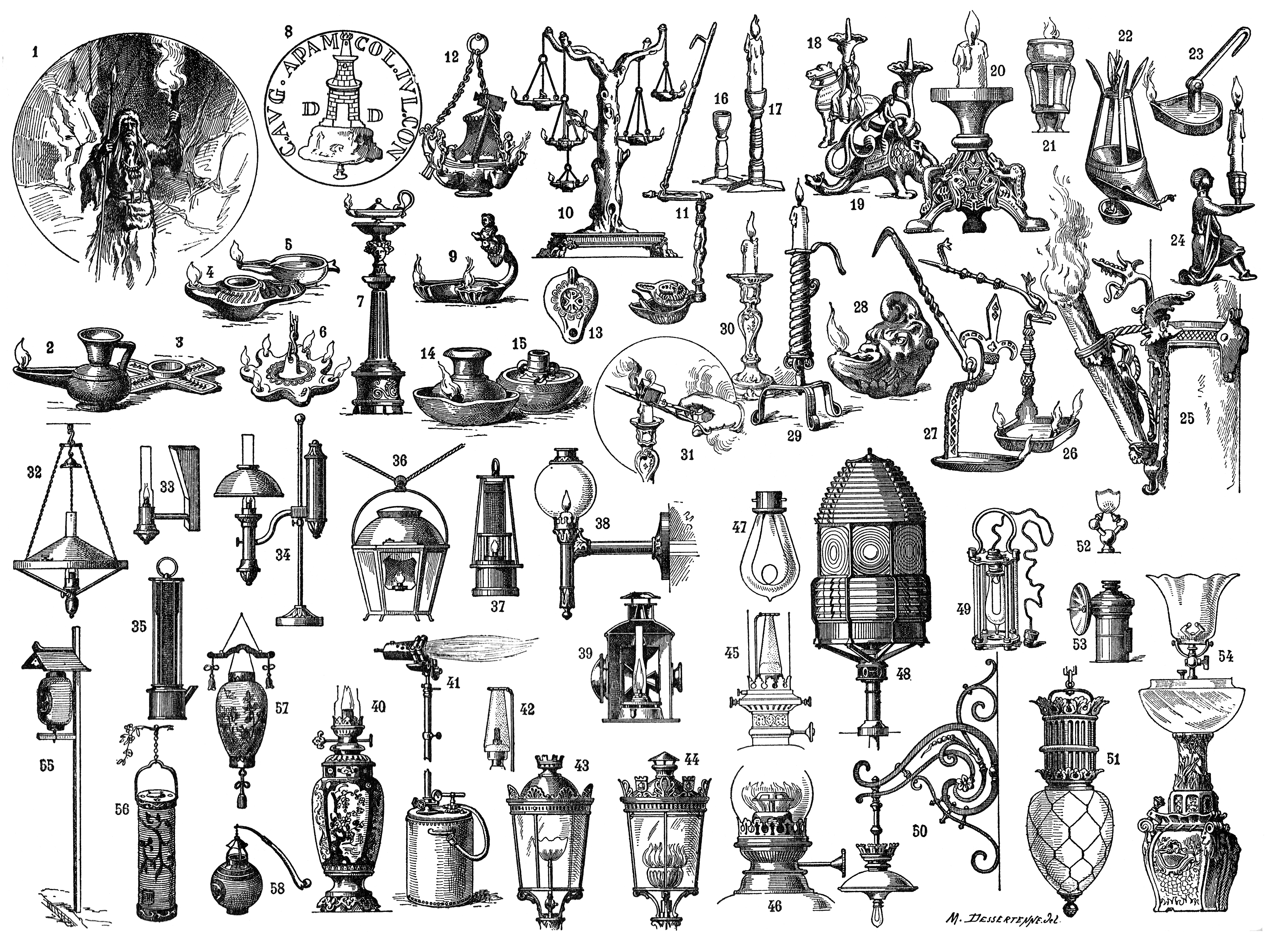
A circa-1900 encyclopedia gathered older flame sources and newer electrical devices on the same plate. Read it as evidence of how its era pictured lighting history, not as proof of the date or appearance of every ancient object.
Maurice Dessertenne, Éclairage, Nouveau Larousse Illustré, tome 4, circa 1900; via Wikimedia Commons · Public domain View source and object record ↗
Preserve function as well as appearance
New uses can require reading light, displays and controls that the original building never anticipated. Stockwell’s American Swedish Institute example shows the value of coordinating those requirements with the historic setting. The practical lesson is to agree on the intended treatment and modern functions early. A visually appropriate fixture is only one part of the design. [1]
A surviving fixture still needs assessment
The Ahwahnee rehabilitation project illustrates why conservation and safety must be considered together. The National Park Service identified anchorage and electrical concerns in historic fixtures and described work by qualified specialists, with historical and architectural consultation. A beautiful surviving body does not establish the condition of its wiring, supports or later modifications. This account is a case study, not a rewiring instruction. [2]
An acorn-shaped light can change its distribution
At Mammoth Hot Springs, NPS set out to retain appropriate architectural character and original pole locations while improving the lighting system. Its project criteria called for shielding, suitable output and distribution, and attention to spectrum. That separates the fixture’s role as a landscape feature from the way it sends light into paths, eyes and sky. Preserving a silhouette need not mean reproducing every unwanted optical effect. [3]
Lighting the collection introduces another constraint
If a historic interior also displays collections, visibility is not the only concern. The IES Museum and Art Gallery Lighting Committee addresses museum lighting with attention to sensitive materials. A restoration project therefore needs both architectural and collection requirements; one generic brightness target cannot stand in for the complete brief. Consult the applicable guidance for the actual objects and exhibition. [4]
Questions to take to a mock-up
As an editorial working method, compare the proposed source in the actual shade or enclosure. Look at seated and standing views, task visibility, reflections, dimming and access for maintenance. Photograph and document the installed changes so future teams can distinguish retained fabric from new work. A warm color label alone cannot demonstrate that a historic lighting effect has been recovered.