
Start with a lamp, not a myth
The Nikola Tesla Museum records an arc-lamp patent application dated March 30, 1885, after Tesla left Edison’s company. It also identifies his Tesla Electric Light and Manufacturing venture. Beginning here gives his lighting story a concrete technical and commercial setting. An application documents a proposed invention; it does not by itself prove widespread use, profitability or superiority over every competing design. The record is sufficient to establish that lighting equipment was part of his early independent work. [1]
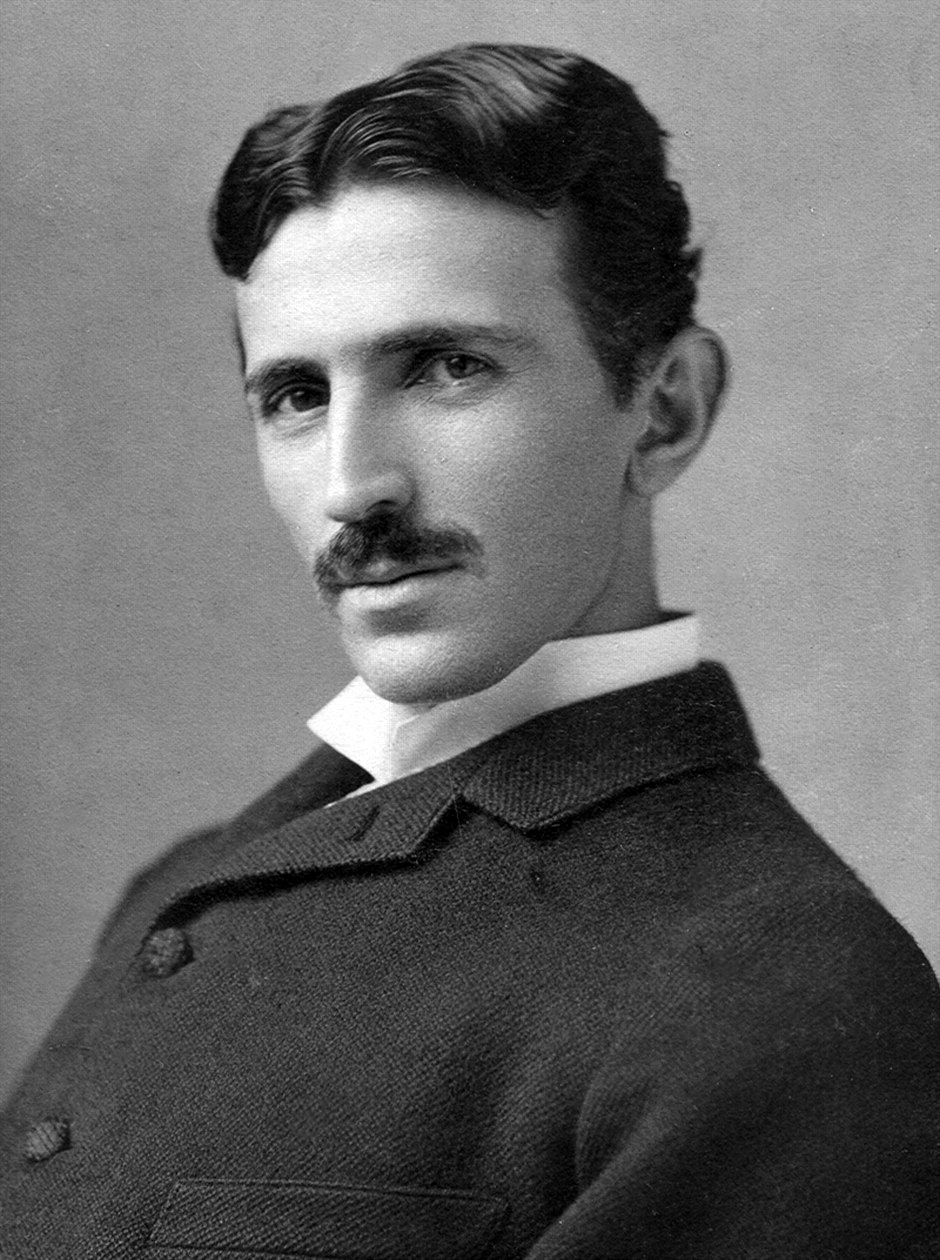
Nikola Tesla, photographed by Napoleon Sarony around 1890. This studio portrait gives a face to the chapter’s account of alternating-current systems and high-frequency lighting experiments; it does not document a particular demonstration.
Napoleon Sarony, circa 1890; Tesla Museum postcard, via Wikimedia Commons · Public domain; author died 1896, published before 1931; Commons public domain mark View source and object record ↗
A motor belongs in a lighting history
In 1888 Tesla presented work on alternating-current motors and transformers to the American Institute of Electrical Engineers. The museum preserves the story of his induction-motor patent, No. 382,279, and its public presentation. A motor is not a lamp. Its relevance lies in the broader system of electrical conversion and use to which lighting belonged. Tesla’s documented engineering contribution therefore extends beyond the visible emitter into the infrastructure making electrical work possible. [2] [3]
A sequence of public experiments
The museum’s lecture record dates Tesla’s New York presentation on high-frequency currents and artificial illumination to May 20, 1891. London lectures followed on February 3 and 4, 1892, including the Royal Institution. In 1893 he presented further work on light and high-frequency electrical phenomena to the Franklin Institute and the National Electric Light Association. This sequence matters because it shows development and professional disclosure across several occasions. It should not be compressed into a single miraculous evening or embellished with dialogue the record does not preserve. [3]
The resonant transformer and experimental light
The museum dates the high-frequency resonant transformer associated with the Tesla coil to 1891. Tesla used this kind of apparatus to investigate lighting, phosphorescence and wireless transmission. It let him explore electrical conditions different from ordinary low-frequency supply. The distinction between demonstrating an effect and delivering dependable lighting remains important: striking laboratory behavior does not establish the practicality of a complete citywide service. This profile makes no claim that the apparatus supplied free energy or that Tesla alone invented the fluorescent lamp. [4]
The larger system reaches Niagara
The Smithsonian connects the Niagara generating installation opened in 1895 with Tesla’s two-phase AC techniques. Its lighting history also describes the growth of larger networks linking electrical supply and use. That development involved manufacturers, engineers, financing and construction. Tesla’s contribution is part of this collaborative infrastructure history. The exact dates of generation, local use and later transmission are separate milestones; this account does not merge them into one event or make a universal first-power-station claim. [5]
What survives when the legend is removed
The documented story is already substantial: an arc-light proposal, motors and power conversion, lectures on illumination and experiments with high-frequency currents. Our interpretation is that Tesla helps readers see lighting as a system problem. Sources, supplies and delivery methods can evolve on different tracks. The primary records below let a reader examine those tracks without relying on anecdotes about limitless wireless power or a simple winner-and-loser account of electrical history.