
A practical route into science
Faraday’s early work was with books. The Royal Institution records his apprenticeship as a bookbinder from 1805 to 1812, followed by his entry into its laboratory in 1813. His subsequent work with Humphry Davy and his own experiments place him inside a working scientific institution. The same career also included public explanation: his candle lectures examined the chemistry of a familiar everyday light source. Published in 1861, they connect the flame-based world of earlier chapters to a scientist investigating forces that would help transform it. [1]
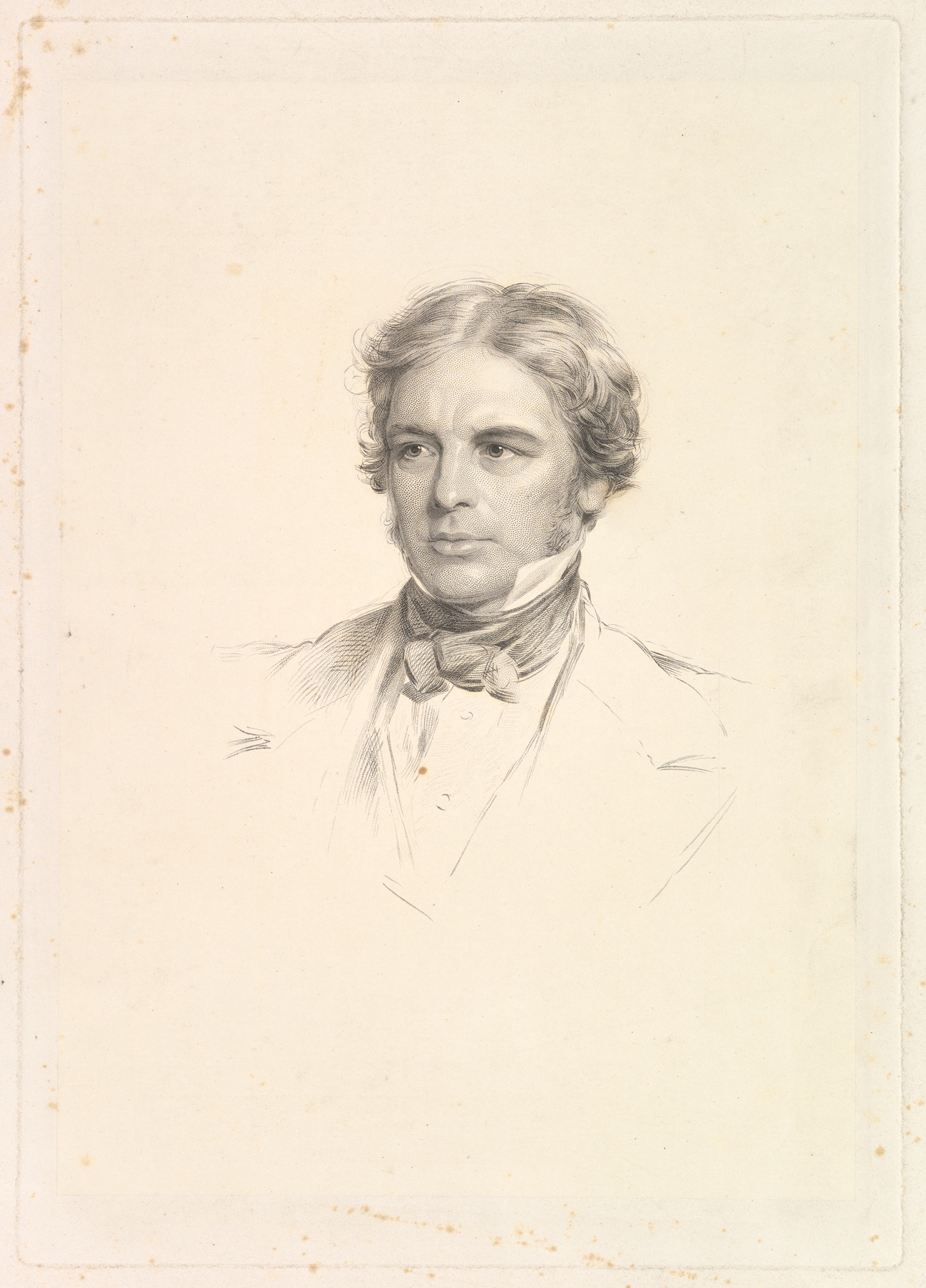
Michael Faraday in an 1852 engraving by William Holl the Younger, after George Richmond. The portrait dates from after his 1831 induction experiments; it does not depict the experiment itself.
William Holl the Younger, after George Richmond. The Metropolitan Museum of Art, Purchase, Brooke Russell Astor Bequest, 2013, 2013.86 · Public domain; Met Open Access, CC0 View source and object record ↗1821: electricity produces continuous motion
Following the discovery that an electric current could affect a compass, Faraday investigated the relationship between electricity and magnetism. On September 3, 1821, his arrangement produced continuous motion of a current-carrying wire around a magnet. The Royal Institution describes subsequent refinements and the circulation of small demonstration models. The significance lay in making an effect observable and repeatable. It was a motor principle, not a lighting installation, but it helped establish a productive relationship between electrical and mechanical action. [2]
1831: the important response was brief
The ring-coil apparatus was a different experiment. On August 29, 1831, Faraday used an iron ring with separately insulated copper-wire coils. Changing the current in one circuit induced a brief response in the other. The short-lived character of that response matters: the experiment did not simply show that placing two coils near each other supplied a steady current forever. It supplied evidence of induction associated with change. The surviving ring allows a reader to connect the abstract principle to materials, construction and a dated observation. [3]
Move a magnet, generate a current
The Royal Institution’s generator object is dated October 1831. A magnet moving through a coil produced a current indicated by a galvanometer. That result provided a route from mechanical work to electrical output. Later engineers developed generators, prime movers and distribution networks capable of supplying useful lighting systems. Faraday’s experiment belongs at the beginning of that physical explanation; it should not be confused with a complete central station. Wind, water and steam can supply motion to electromagnetic generators. Solar photovoltaic cells follow a different conversion mechanism. [4]
1845: magnetism changes the behavior of light
Faraday also investigated light itself. His magneto-optical experiment passed polarized light through glass in a magnetic field and observed a change in its polarization. The Royal Institution preserves the apparatus and dates the work to 1845. The result, known as the Faraday effect, supplied an experimental link between light and magnetism. It adds a second dimension to his place in lighting history: he helped reveal relationships governing both the energy supply and the physical nature of light. [5]
The legacy behind the fixture
Faraday did not create the practical commercial incandescent lamp or the utility grid. His story concerns the experiments and physical principles on which later systems could build. That distinction makes the history richer. A lamp depends on discoveries, materials, instruments, engineering and organization accumulated over time. Our interpretation of his contribution is a reminder to follow those dependencies backward, rather than beginning and ending the explanation at the glowing bulb.