Electric lighting had more than one beginning. The brilliant arc and the glowing filament solved different problems, and both depended on a practical supply of electricity.
Early nineteenth-century experiments produced an electric arc between carbon rods. Generators made arc lighting more practical in the 1860s and 1870s. Its intense light suited streets and large spaces, but the carbon electrodes were consumed and required replacement. This was electric lighting before the familiar domestic bulb. [1]
02
The filament: light from something hot
An incandescent lamp passes current through a resistive filament until it glows. A protected atmosphere limits rapid destruction of the filament. Many inventors contributed to this development. Joseph Swan worked on carbon lamps in Britain, while Edison and his laboratory team pursued a practical lamp and distribution system in the United States. [2][4]
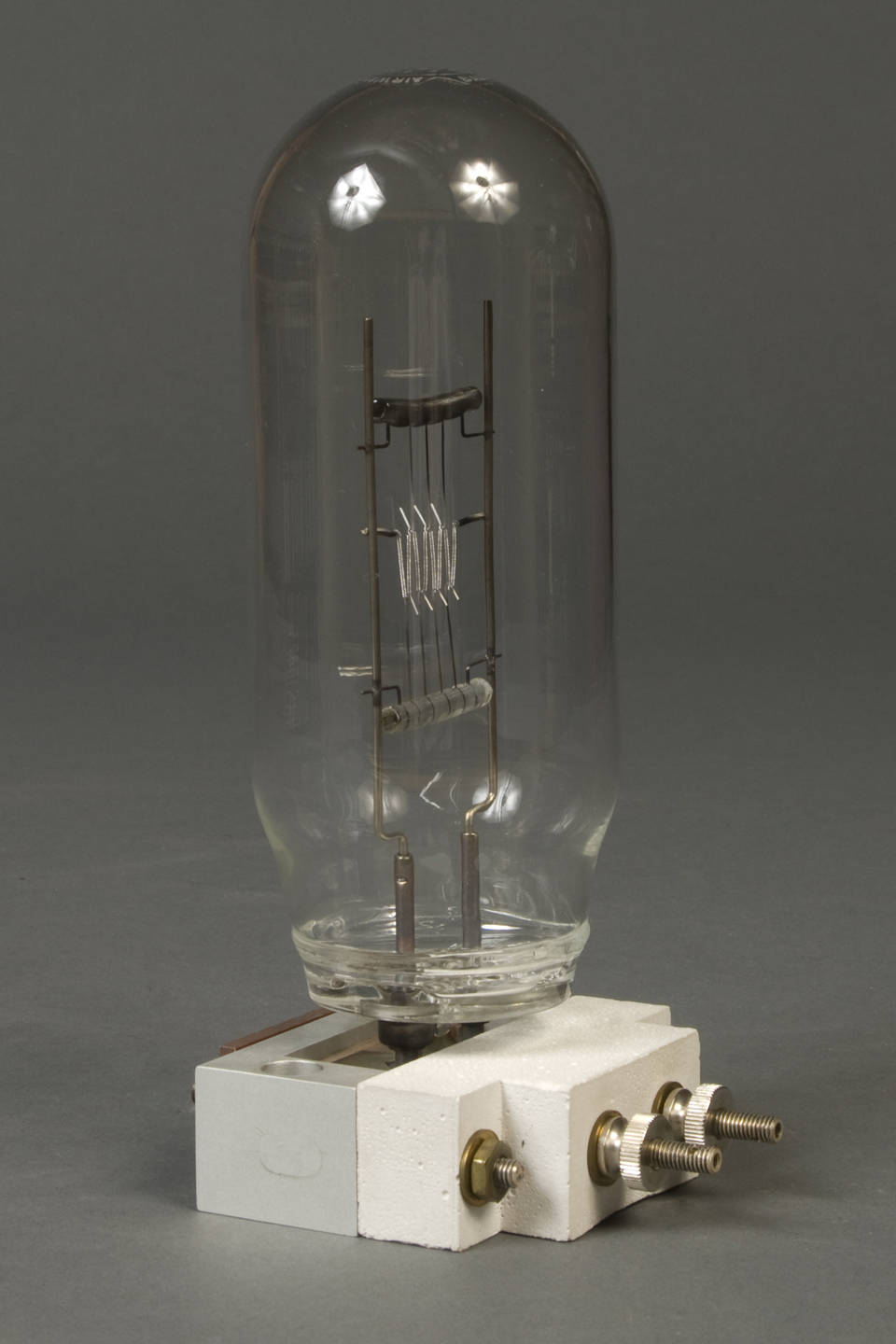
From wick to filament: this unlit 500-watt incandescent standard lamp was used in the 1970s. Its visible construction illustrates a later, refined technology, not Edison’s 1879 prototype.
NIST · NIST public information may be copied and distributed except material marked copyrighted; image credits requested View source and object record ↗
03
1879 was a milestone, not the whole invention
Edison’s team achieved a long-burning carbon-filament lamp in the autumn of 1879. The National Park Service specifically cautions against an often-repeated exact test date. The useful invention also included generation, wiring, switching and metering. A bulb without that supporting system could not transform daily life on its own. [3]
04
A new system spread unevenly
Electric service expanded, but older lighting survived alongside it. In 1882 Edison’s company brought electric light to parts of Manhattan. Filament materials also changed: tungsten lamps and improved gas-filled designs followed in the early twentieth century. The new century would develop other ways to make light besides heating a filament. [3][4]
MARKERS IN TIME
A chronology, with context.
Early 1800s
Electric arc experiments
Light from an electrical discharge between carbon electrodes.
1860s–1870s
Practical arc systems
Generators help move the arc beyond the laboratory.
1879 / 1882
Lamp and distribution milestones
Edison’s laboratory work and the expansion of central electric service.
THE LIGHTING TOOLKIT
The sources—and how they work.
Lighting technologies covered in this chapter
Source or system
Principle
What it changes
Carbon arc
Electrical discharge across a gap
Intense light; electrodes require maintenance.
Carbon-filament incandescent
Electricity heats a filament
Smaller light sources suitable for indoor use.
Tungsten incandescent
A high-temperature metal filament
A refinement of the thermal-light principle.
Electric distribution
Generation, wires, meters and switches
Enables lamps; infrastructure is not itself a light source.
THE EVIDENCE DESK
History worth
checking.
The bulb cannot accurately be attributed to one inventor. This chapter distinguishes experiments, useful lamps and complete electric-light systems, and avoids a disputed exact 1879 test date.
Dates and technical claims are checked against museum collection records, peer-reviewed research, government publications and scientific institutions. Text is an original synthesis, with numbered references beside factual passages. A date for a surviving object is not treated as an invention date.
Images are selected only when their source, subject and reuse basis can be identified. Collection photographs, scientific false-color images, modern experiments and explanatory diagrams are labelled separately. Image credits below document provenance; they do not imply endorsement.
Research reviewed October 4, 2026. This first edition covers major source families in six connected chapters. Regional traditions and dates remain more complex than any short linear history.
BEYOND THE HISTORY
Understand the science behind the story.
Explore IES-based definitions, design practice, standards and transparent calculation tools.