
Argand: improving the oil flame
Argand lamps used a circular wick with air reaching both sides and a chimney to encourage airflow. The design belongs to the late eighteenth-century effort to make oil lighting brighter and more stable. Whale oil was one fuel used in lamps; in nineteenth-century America, kerosene and other petroleum products increasingly displaced it. [1] [2]
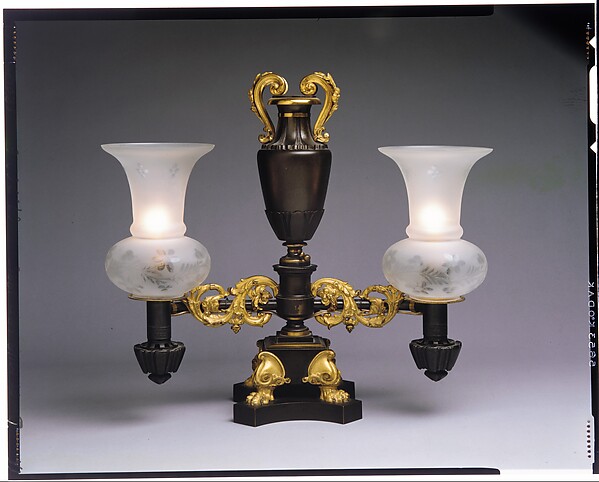
Look at the burner and the chimney: the Argand system managed air as well as fuel. This museum example dates to 1835–40, later than the original development of the design.
The Metropolitan Museum of Art, Gift of John C. Cattus, 1967, 67.262.6 · Public domain; Met Open Access View source and object record ↗Gas moves the reservoir elsewhere
William Murdoch lit his Cornwall home with coal gas in 1792. Frederick Winsor demonstrated gas street lighting in London’s Pall Mall in 1807; public gasworks and distribution followed. Instead of filling each lamp with liquid fuel, a network carried combustible gas to burners. The lamp was now one visible part of a much larger industrial system. [3]
A brighter flame was not free of costs
Gas extended lighting in factories, streets and buildings, but adoption was uneven. The National Gas Museum notes that many working households in Britain could not afford it until the late nineteenth century. Gas mantles, introduced in 1885, produced brighter light from heated material rather than relying only on a luminous open flame. [4]
Special tasks created special lights
Lighthouse optics redirected light into useful beams: Fresnel completed a flashing-lens design in 1822. Limelight used heated quicklime for intense illumination. Later carbide lamps generated acetylene from water and calcium carbide, then burned the gas. These branches remind us that street, stage, mine and maritime lighting had different requirements. [5] [6] [7]